

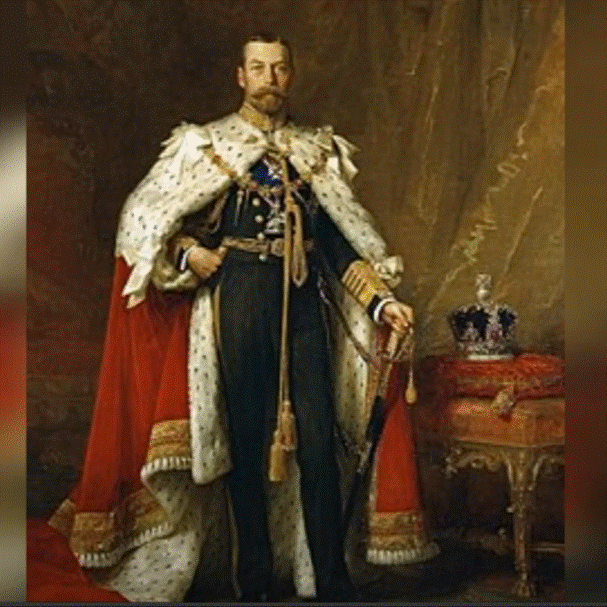
King George V passed away eighty- nine years ago today, on January 20, 1936. Queen Elizabeth II’s grandfather was monarch for twenty-six years after significantly modernizing the monarchy.
King George V Made An Enormous Impact On The History Of The Royal Family
The King changed the royal family’s name to Windsor, which was applied not only to the name of the “House” or “dynasty” but also became their official surname.
George V also started the annual Christmas radio broadcast tradition and made the monarchy more accessible to the public and working class. He navigated Britain through the First World War. As King, he accomplished a great deal.
His importance to the history of the monarchy is part of why the circumstances of his death have been closely examined, and claims were made fifty years following his passing.
In 1986, it was revealed that George V had been “euthanized” by his doctor, Lord Dawson. A “mixture of cocaine and morphine was administered” and injected into His Majesty on his deathbed. The King had suffered from smoking-related health issues during the final years of his reign.
The incident was reported by Andrew Morton in the Daily Mail in November 1986 after diaries written by Lord Dawson were discovered.
Approval for the injection was given by the King’s wife, Queen Mary, and his son and heir, Edward VIII. Seeing as there was no such thing as hospice care back then, the doctor decided to give the ailing King a lethal injection to end his suffering.

Apparently, he also wanted to ensure he passed in time for the morning version of the Times, the King’s favorite newspaper.
Lord Dawson Could Have Been Prosecuted
Lord Dawson’s medical notes explained the reasoning behind it,
“The determination of the time of death of the King’s body had another objective in view,”
He wrote.
“The importance of the death receiving its first announcement in the morning papers, rather than the less appropriate field of the evening journals.”
The doctor could have been prosecuted for murder. However, he only shortened the King’s life by mere hours, not days.
Sir Douglas Black, a prior president of the Royal College of Physicians, remarked that what Lord Dawson did was “evil.”
When Queen Elizabeth’s press secretary, Michael Shea, was asked about it,
He responded,
“Our comment is that we have no comment.”
In another one of Lord Dawson’s diary entries, he wrote,
“About 11 o’clock, it was evident that the last stage might endure for many hours.”
He added,
“I, therefore, decided to determine the end and injected three-quarters gram of morphia and, shortly afterward, one gram of cocaine into the distended jugular vein.”
Was It Murder Or Euthanasia?
Was it murder or, as they so delicately put it, “humane euthanasia?” In the end, it brings up all kinds of questions about whether hospice is a peaceful ending to an illness or if it is murder. Some view hospice care as playing God with people’s lives.
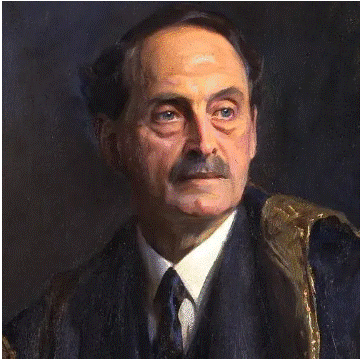
Others insist it’s the compassionate way for someone’s passing to be facilitated. Lord Dawson’s family defended his decision in 1986, saying that he wasn’t just the King’s doctor but a close family friend of the royal family.
The King was born on June 3, 1865, and was not expected to be King. His brother, Prince Albert, died in 1892.
George married his brother’s fiancée, Princess Victoria Mary, in 1893. She was later known as Queen Mary.
The couple lived at York Cottage in Sandringham and had six children. Goerge was made King in June 1911 following the death of his father.
King George V died at Sandringham House in Norfolk on January 20, 1936.
Royal expert Angela Levin once made this chilling statement about King George V’s death:
“It’s a very dark but interesting mystery.”
Daily Soap Dish fans, let us know what you think by dropping us a line with your thoughts in our comments section below.
